Sunday, February 24, 2013

Drive VR Seed Before Planting

This Friday we took a field trip from the office.  We loaded up our GIS Tech team and a couple Agronomists and two Trailblazer and went out to the field with a laptop and Farmworks Sitemate installed with a GPS puck and drove some snowy fields.  Our objective?  Check out some new VR-Seed rate files.


Over the course of several years, we sometimes run into farmers that dislike our prescriptive maps.  (odd, huh? but true.)  Most of them are very understanding and chock it up to a learning experience to improve upon next season.  However, we always take it to heart and work to make them meet their objectives.  One such way is to load up a file on a laptop and do some pretend farming while the soil is frozen.  This is also a great way to get our computer geeks out to the field and "feel" the changes as if they were farming it.

So how does it work?  We basically just drive up and down some rows, through some low areas and basically just looking for places that might be "weird" in the map based on the current position.  During this particular run we found that some of our logarithmic logic wasn't quite as smooth between SSURGO zones as it appeared on the map.  We discussed how we would change the parameters in the algorithms between stops.


We visited another field with some different logic applied to it.  The maps looked much better.  In fact, the particular fields we traversed had both extreme hills, along with minor topographic changes.  There were stark changes in soil color, and moderate variations, all within the same 200 acres.  A stiff boot heel kick into the soil made checking soil color easy, as well and the driver going to what he perceived to be "a good area" and then the laptop operator stating the rate out loud.

All in all, we learned a lot about what made the algorithms work and where we needed to make adjustments (and some ideas about specifically how.)  It was really cool to see the maps locate and accurately describe just slight changes in the field that you could intuitively perceive.

What tips do you have to prevent waste on your farm for the 2013 crop?  Do you ever "pretend farm" as a way to help you learn?

Wednesday, February 13, 2013

Improve VR-Seed by Subdividing SSURGO data by Slope


Farmers often use SSURGO soil type data to assign seed rates.  Their main assumption relates to water holding capacity and organic matter as these macro soil attributes greatly influence ability to support higher populations.  However there are some limitations to this public data set.  They blame various things, mostly related to resolution (aka "the darn lines are in the wrong place.")

When frustrated, farmers sometimes ask for normalized historic yield maps to improve or replace SSURGO data.  However, when we’ve done this we often encounter resistance when they finally get to the field.   Why?  Because it ends up assigning low rates to “good soil” that they have tiled or otherwise improved.  Often times the yield data has problems, like switching varieties, missing data in middle of a field or only a few years of “good data.”  We can over exaggerate underlying soils rates but all this adds up to conceptually liking the idea but practically avoiding it given lots of poor quality yield data.  Can you say, tail wagging the dog?!

A long time goal of ours was to better describe predicted soil moisture using slope.  Despite the ease at which one can look and perceive slope from an elevation map it is quite challenging to mathematically capture it in most existing GIS software.  Well, we finally accomplished just that… both max-grade and position on hill… top or bottom portion of the hill itself.

Above is a corn yield map from drought stricken 2012 field.  As you can clearly see, the yields don’t change exactly with the specific soil type zones change.  However, it's decent, albeit, not perfect.  Where "off", is that because they are wrong or because a B slope soil type is simply too great a generalization for this application?   Said another way, B slope simply means gently rolling, but doesn’t say “this is a hill top.”  Sometimes it is, but often it has hill tops and valleys both, which yield differently.   Given the tabular data quality of the SSURGO maps (and their ease of retrieval,) we’re not convinced we should abandon them just yet.  Instead, how about we improve it?

Below is a VR seed map for corn with original SSURGO map overlaid.  You can see how the slope extends the normal zone rates across various soil types.  To accomplish this we started with a VR-Seed map based on soil type and then used some logarithmic math to distribute based on a proprietary slope algorithm.  The lower position in the hill (at same slope) gets more seed than does the same slope toward the hill top.  In fact, the math effectively describes the concave or convex proprieties of all “hills and valleys” at the given 100 ft square resolution.
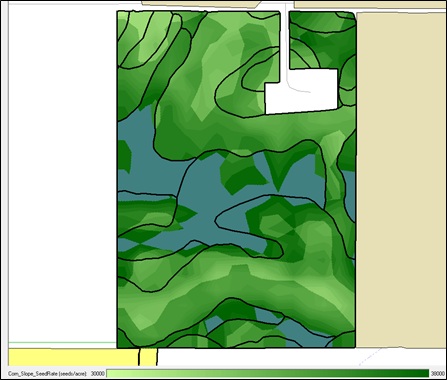
Additionally, this VR-Seed file means that the farmer won’t have those hard polygon transitions while traversing the field.  In fact, the rates will gradually shift higher or lower as he transitions between soils and varying slopes.  Same soil type but in a valley?  No problem… we’ll drop more seed.  Same soil but on the top of the hill?  No problem, we are dialing back.  This elevation influenced data is able to be accomplished even with WAAS data because of the relative nature of slope position and 100 ft horizontal resolution.    The ultimate result is a refined seed rate without a crop consultant even visiting the field.

The final map is our proposed VR-Seed map for soybeans.  As you might notice we invert the rates to lower population to prevent lodging in the appropriate positions in valley of high OM soil types.  At this point, we believe a good farmer could “trump” these maps with his knowledge about drainage, fertility or other oddities not represented in these two data sets that make his soils different than the underlying SSURGO properties.  (or, subdivide his SSURGO using smart zone soil sampling first and then apply this slope logic afterward!) 

We look forward to bringing this to more customers as we streamline the algorithms and make it easy for more people to deploy inside Optmzr

Monday, February 4, 2013

My first ever re-blog Post

If you've ever wondered about staying power, technology and convergence of mind, guts and glory on the farm... look no further than my friend Brian Scott, aka @TheFarmersLife.  Nice post about Super Bowl commercial that incorporates his family.

http://thefarmerslife.wordpress.com/2013/02/04/ram-trucks-wins-superbowl-with-so-god-made-a-farmer/

I'd say more but his post says enough.

Daryl

Monday, January 21, 2013

Maybe we need to start a call center?

"Help, I'm addicted to big corporations and am sick of it." That'd be the mantra of my new call center. We'd take inbound calls from distressed farmers who's production practices are being prescribed by the same corporations that engineer their seed.

Now if this doesn't sound like a cataclysmic opener to an organic leftist tribal chant, I'm not sure what does... however, I must say that I'm starting to lose respect for the "rugged independent" nature of the American farmer. Heck, even in Ancient Rome they used to hold up the farmer as a necessary occupation in society that was able to voice their opinion without threat of customers leaving them.

I've come to learn and respect a few of the "agvocates" still out there. The AgChat Foundation is delving out some pretty nice dialogue and blogs via Twitter, Facebook and more. These organizations appear to be led by some fantastic people who have a grounded approach. My concern however isn't so much about the education of the non-ag community, but rather the education of the farmers themselves.

For the last hundred years or so, our land grant universities have provided a third party resource of replicated trials to improve farm practices and advanced cropping systems. As the industrialization of ag has evolved so has their funding, and now the only research that gets done is somewhat tainted by the requests set out by the funding grants, often deployed by the same multi-national corporations.

Trade publications are also a source of information for many farmers... particularly favorable to the advertisers therein. No doubt these folks have to make a living through ad space but do they really have large enough budgets to advance the science of farming? No, their role is to give a comprehensive presentation of what the goings on are in ag are at the present moment.

Some 15 or so years ago many people thought farmers themselves would develop more on-farm research protocol through the use of precision ag technologies. Farmers were expected to lay out large block trials and then scout and record yield data... even process the data in the winter for new insights. The trouble with this is the same in other commodity industries like mining or t-shirt manufacturing... they simply cannot leverage the R&D necessary to convert the investments in significant research into value on the other end of the production chain. It is simply in their best interest to adopt early and deploy cost saving measures widely and quickly.

The trouble with zero R&D and early adoption being the best business model is that as we enter the information and communication age of agriculture the rate of adoption will actually accelerate and the margin for competitive error will erode. As land changes hands the production systems go into fewer hands and become necessarily closer to their vertical suppliers. Perhaps that is just natural but I'm just not certain I trust the stock market and government to oversee the stewardship of our land.

The good news is that I've met a growing segment of medium/large growers that have built both cash reserves as well as fixed equity and are turning toward technology to garner greater insights into the actual needs of their farm. With faster information flow these growers are leveraging their own management of their systems and becoming better managers of water, soil health, sunlight and other basics that are very, very low cost to acquire compared to their long term benefit to their business. As landowners recognize the separation in their systems approach they are acquiring land under favorable terms and setting themselves up with a multiplicity of suppliers with more equal yoking.

If anyone happens to read this article and feels compelled to join me in the call center, please let me know. I'm not much for sob stories but would appreciate helping a few people use their brains.

Thursday, January 17, 2013

Using Precision Ag to Save Money or Yield More?

A recent publication from PrecisionAg.com http://www.precisionag.com/article/32148/soybean-research-summary-downloadable-pdf-now-available  inquired of the reasons farmers use precision ag. The main thing that stood out to me besides row crop farmers love of machinery, is the fact that there are really only two reasons to adopt any type of increased precision in your farming system.

1. Cost savings - these normally amount to reduced input application. GPS soil testing and VR fertilizer application are used to avoid over application of P & K. Most early adopters of variable rate seeding have done so to reduce total units of seed purchased, either through guidance, row shut off or reduced populations on their thinner soil types. From my point of view these motives are fine but are somewhat short sighted and not very inspiring, particularly for the high yield kings of the neighborhood that know the best way to reduce ALL input costs is to raise higher yields.

2. Increased yield - Fewer people, but still a significant amount, responded that their main reason for adopting variable rate was yield gains.  Of all aspects the stand out was variable rate seeding with nearly 60% indicating yield gains were main reason for adoption.  Still, guidance, row shut off, and other implement controls were touted as a means to increase yield by improving placement.  This is unfortunate but very revealing of the state of the industry.  Variety to soil matching or variable rate seeding was not touted.

What do we need to change this?  Please comment!

Thursday, December 27, 2012

Best Non-Ag Apps for Ag

Did you get a new smartphone or tablet for Christmas?  Or, just searching for some new apps to freshen up your device?  Well, here is my short list on my iPhone and iPad. Hope it helps you organize and enjoy your smartphone or tablet all the more!  (I believe most, if not all of these are available for Android or Windows devices, too.)


  1. Evernote - Although not ag specific, this handy app allows me to jot down ideas and copy/paste links and articles from a variety of sources while on the go.  I can access it from my phone, tablet, laptop or desktop and it's always in sync.  I've even heard of some savvy farmers using it for field record keeping.  It's searchable and really flexible in how you organize it.  Be creative and don't forget a thing!
  2. Pandora - I'm always on the move but one thing is always with me... my smartphone.  I have a decent iTunes library of songs and a few audio books (read more later), but I really like Pandora because it suggests songs I might like based on other tunes.  This is fun when I'm in the middle of no-where and needing some inspiration.  Play me something like the Black Keys.
  3. Box - (or DropBox).  We use www.Box.com to share soil sampling and crop scouting files with our customers.  This little app allows me to find them when someone calls with a question.  It's also super handy as a farmer to access files we've shared.  Or, if you're feeling ambitious simply upload your own files to your own account and then get them when you are out and about!
  4. GoToMeeting - It's better on the iPad than iPhone, but still, having the ability to join a webinar meeting virtually while you are out in the field is pretty amazing stuff.  At a minimum, I encourage you to call in and join these so you can network with colleagues around the country.  With the app, you can share web camera and see their computer screen as they operate it.  Cool stuff.
  5. Google Latitude - My wife texts and calls me to ask where I'm at almost every day.  Now, with Google Latitude, she can simply look me up from her phone or computer... see where I'm at and estimate when I'll be home for dinner... if my appointment doesn't run late!  It's accurate enough to track me walking back through some strange field.  Some people think this is a little weird but you can control who you share your location with and that means it is really up to you how you use it.  Besides, big brother is tracking you already, anyways, ehh?
  6. LinkedIn - This app is actually my favorite source for news and "social" connectivity.  I get my business news and heartbeat of industry happenings here.  It's also a good place to get feedback on particular questions via the Group areas.  Download app and connect with me:  http://www.linkedin.com/in/darylstarr
  7. WeatherUnderground - I've tried so many weather apps but this is the one I keep coming back to.  Besides a really simple GPS based "find me" solution the radar is good and can be easily set in motion.  Additionally, we use it for part of our weather in www.Optmzr.co so that just makes sense.
  8. FeeddlerRSS - Organizing RSS feeds in one place is a pretty big deal.  If you are not an RSS user you should Google it and start thinking about it.  It can really streamline the overwhelming amount of information by setting up some auto-sort and filter parameters.  Additionally, I use Google Alerts for particular key words and send them to Feeddler so I can be alerted about things I'm actually interested in digesting and sharing.  If you know yourself, this will help you listen better.
I hope you enjoyed this short list.  If you can't tell by now, you can guess that I didn't want to post a bunch of the same ol, same ol in the app for ag domain, but instead wanted to provide you with some enriching ideas that I have used to help my mobile productivity.  Enjoy and please share your favorites with me in the comments section below!


Tuesday, December 18, 2012

High Yield Soybean Management After a Drought Stricken Corn Crop

I've talked a lot about impact of drought and carry over effect. Tonight it struck me that soybeans deserve some attention related specifically to left over nitrogen after drought stricken corn crop.

In my studies, I believe nitrogen has two main effects on the soybean plant. First, it increases internode length during vegetative stages. Second, it helps maximize conversion of dry matter during grain fill.

Commonly known but not widely published is the fact that soybeans require 5# of N per bushel. The plant can fix about 70% of its needs from the atmosphere and rhizo bacteria. The balance must be met from soil mineralization or supplemental fertilizer. For extremely high yield soybeans (70bpa+) they can run out of N in average soils.

Not surprisingly, high yield soybeans tend to follow high soil N mineralization springs and summers. With ample rain, additional N late can capitalize on available potential.

One interesting consideration for soybeans after drought stressed corn is the potential for residual Nitrogen. If it makes it to grainfill that could mean bushels. However, the more likely situation (not likely, but MORE likely) is that spring available N is higher than normal. (most of Indiana soils are still not saturated as I write on this 18th day of December.) Since soybean internode length is increased by N in early vegetative stages this may simply translate into taller beans and more shaded growing points, fewer nodes and flowers... and reduced yield potential. What should you do?

Plant early and reduce populations to compensate for higher N load. You're likely to get as much or more nodes and similar canopy dates. Ultimately this can translate into higher yield potential, along with reducing costs and lodging risk. The worst practice is probably abnormally high pops drilled in narrow rows on high OM soils following a drought and dry winter. You'll have tall, lodged soybeans that might yield in the 40's (but they'd be nice baling!)

Hopefully this provides you some food for thought. Happy planning!

(I drew this picture, mapping nodes, pods and distribution. Did you know 80% of yield is normally in bottom seven nodes?)