Tuesday, April 16, 2013

What do software developers have in common with farmers?


This weekend Optmzr.co is being honored at the Techpoint Mira 2013 award gala.  This event is expected to draw more than 1,000 attendees, most of which will be wearing tuxedos and evening gowns to what is affectionately known as the "Oscars of Technology" for the state of Indiana.  My wife and I are attending because our company's software tool, Optimizer 2.0 was nominated by some of our developers as "The Innovation of the Year" (and some other tech people considered it worthy of being a finalist... read more here.)

This gala is unlike many award ceremonies that I am used to, often featuring a cowboy comedian or a slideshow of farm scenes... instead, we'll be surrounded by tuxedos, ice sculptures and videographers.  People will be tweeting and snapping pictures of each other in silly poses for their "social media strategy."  All that is fine but somewhat Oscar-like from my point of view which is to say... weird.

However, I don't want to down play the significance of this event or the motivation of the people behind it and being recognized.  There truly are some exemplary thought leaders and innovative people involved.  Several companies can trace significant growth as a direct result of being honored, while other Indiana companies have gone on to successful IPO's and international significance.  Indiana has a budding tech scene and celebrating these accomplishments is an important motivator for many involved... and well deserved.

So what do software developers have in common with farmers?  Both start with a foggy vision of what they want to grow, and how their work might materialize.  They invest significant lonely hours, pouring heart and soul into the seeds of their idea.  They shepherd their vision and act as stewards of their growing project and adjust both their visions and efforts according to what is practically most urgent.  Both must exercise patience and faith.  They live a daily mantra of "If I seed it, someone else will add the growth."  Timing is also critical for both.  Too much too early, or too little, too late and failure becomes imminent and apparent to both themselves (often later) but first to the on-looker.  In the end, both the farmer and the software developer hope to build a fertile environment that perpetuates healthy returns for years to come.  It's not always easy or pretty, but with hard work and some good fortune (luck?) they both can enjoy the fruits of their labor and talents.

I'm going to this event to celebrate Indiana technology and the common thread of an enterprising people group.  I realize we wouldn't be there without our team's hard work, or our farmer's adoption.  Hopefully the others in attendance won't mind my work boots... there is still a lot to do!

Saturday, March 23, 2013

Why the Term "Prescriptions" is Dead

I started writing prescriptions when I was a teenager... and I'm no Doogie Howser.

Honestly though, why did precision ag start using the phraseology "Rx" and "Prescriptions" and "Scripts?"  My theory is that the original power users of precision ag software either had a PhD or felt like they deserved a PhD for figuring out how to use the stuff.

In the coming years Variable Rate file generation will not require a PhD.

And why should they?  I have farmer customers that build and download their files from their smartphones... fast and easy.  I know of no other business manager that asks a "doctor" what they should do next.  Rather than getting a prescription for some ill condition, most savvy business managers look to adjust plans to preempt painful conditions.  As such, they are comfortable with limited knowledge and willing to accept some risk.   This is quite unlike a doctor who tests, diagnoses and prescribes treatment AFTER symptoms have revealed themselves.

Certainly there is good reason to use sound statistics and mine spatial data for insights regarding trend forecasts.  Every good manager needs insights and forecasts based on their actual data.  There is certainly a role for consultants and suppliers to play a relationship role in helping shape parameters for the controller files, but the setup and delivery needs to be fluid and adaptable if for no other reason than the weather changed the circumstances!

So what should we call it?  Let's just call it "Download file"  or "Crop Plan" or "VR File"  or something less suggestive and more accurate.  The emphasis shouldn't be on making us some software/research demi-god but rather on the agreeable logic applied to match up with the farmer's own strategic vision for his farm.

Instead of building software that is suitable for a demi-god only, let's write software that normal humans can run.  No certification required.  Let's make it fast, easy and fun... and profitable for the farmer and the salesman.

Friday, March 15, 2013

Weld Smartphone to VR Controller

"I've been building variable rate files since before smartphones." - Old timer Precision Agronomists

Mark my words, this will be something the old timers will brag about.  This week, a customer of ours downloaded variable rate shapefiles from his smartphone and transferred them to his Ag Leader monitor... through a USB cord he had laying around.  Yep.  It is real.


No offense to Nathan, but he doesn't have a computer science degree or anything crazy.  He is like a lot of other farmers... he has determination and ingenuity.  This week, he and "his precision ag guy" Travis from Case dealer, Jacobi Equipment in Columbus, IN simply got inspired to try and make this simple idea work... much like my dad or others would weld together some objects to make life easier on the farm.  And after downloading an app to unzip his prescription download, he was able read the files straight from his phone into his monitor.  Done.  No USB thumbdrive needed.  

"No more USB drives for me," said the dealer.  Now he can download and install updates to customer's monitors at will.  Besides that convenience, he could also simply email the customer and allow them to download their own firmware updates and install from their own phones while in the field.  

When I heard what Nathan did, I started jumping around our office, doing a little dance and yelling.  Sarah and Lauren think I'm crazy anyways so no big deal.  I was excited because not only did I not even ask this customer to try this but I knew that he saw what www.Optmzr.co could provide him and how immediate recommendations that are updated by the weather could have an impact on what he wanted to do in the field in real time.  He saw it and simply couldn't wait for us to build an app.  He didn't check with his corporate attorney or ask permission from his boss.  Instead, he tried it on his own and made it work.  I love farmers!

The result is that while planting he can download a new rate file at his whim.

Nathan shot video of process above.

What does that mean exactly?  It means that after building his best laid cropping plan (variety by field), he has a solid plan B in his shirt pocket if the weather dictates something different... What if the next field east is ready to plant but he has a planter full of wrong variety?  Seem complicated?  I mean, how does he retrieve Plan B when it isn't even built yet?  Well, Nathan will simply pull out his smartphone while finishing planting one field, tweak variety intentions for the next field, download his files and begin planting his new prescription in the next field... using all the available weather, soil and seed and timing data at his fingertips...  all done without calling, texting or paying for additional data plans or equipment!

That is farmer ingenuity at its best.  Want to download the exact How-To that Nathan gave us?  Make a comment and we'll trade emails!  "Weld your Smartphone to Your Monitor with a USB cord."

Monday, March 4, 2013

Use Soil Tests for VR-N

What is the most important soil property for managing variable rate nitrogen?  Soil organic matter (aka OM).  

For dozens if not thousands of years farmers have inherently known "good soil" from "poor soil."  The first and most obvious is the color and smell.  Both of these sensory elements relate to the break down of organic matter... decomposing carbon material... dead plant and animal life and manure.  This natural compost is biologically active even after losing the original plant shape.  Microbial life is busy eating and converting material into energy and releasing nutrients that help new plant life flourish.

Soil Test Upload Screen

There is a lot of work in modern agriculture to refine variable rate nitrogen.  Improving the rate and timing of nitrogen is important for improving water quality as it is managing costs and yield on the farm.  As one of the single most expensive inputs on the farm, nitrogen is also high on the list for farmers to manage well.  However, it is very complex given the mobility and variability within the field.

Rather than explain the entire N cycle, I would like to share and propose the use of soil test OM values to improve nitrogen rate decisions on your farm.  At a minimum this approach can provide you some base guidelines for how "good" exactly is your soil.  In some more complex treatments, you might also model the nitrogen mineralization from the OM based on soil moisture and temperature properties.  This can empower you to tweak timing and understand plant stress at various growth stages.

We work with a farmer that has taken soil samples on 1 acre grids and uses OM to drive his VR seed and VR nitrogen rates.  Still others we work with deploy ISNT or other measures.  Every farm and farmer is unique so approach this with your own smallest management unit... for one, subdividing a soil type will be enough, while another will want a tighter grid or even some higher resolution soil color sensor.

A simple suggestion to step up from just the basic SSURGO soil type maps would be to subdivide your SSURGO zones for a modified grid soil test.  In so doing, you take your soil test in smaller zones which better describe patterns within the field (agree or not?!)  Then you would use the OM value from your soil test and assign an anticipated nitrate release through the growing season.  When you build out your nitrogen budget you can then deduct this soil contribution!

Piece of cake, right?!  Well, not quite... since any field with large variability in soil OM probably should also have variability in yield goals within the field.  If that is the case (which is normally so), then you'll want to adjust your gross N needs before deducting soil contributions.  In some cases this might even things out, but in many areas, your yield goals might be nitrogen limited because of historical compromises you've made elsewhere.  What do I mean by that?  Perhaps you've been shorting nitrogen rates in that "medium" textured soil because you didn't want to over do it on the poor soil?  You've had enough seed and water, but ran out of N.  Not good!  So, is the answer applying a higher straight rate across whole field?  Not if you want economics or environment to pan out well for your future!

In this way, we believe it is critical to compile ALL aspects of the soil that can effect yield and nitrogen movement.  You can make significant strides in cost savings and efficiency by doing a good job creating zone specific yield goals and working backwards from that.  However, the true yield gain values are wrought after understanding what of your soil can be managed to optimize performance.  That is, what is most limiting?  Fix it, then ask what is now most limiting.  Fix it, then so and and so forth.  (ever heard of Game Theory?!)  When this is applied to nitrogen as it is relative to other aspects of crop growth you stand better odds of increasing yields along with improved N efficiency.

If you'd like to know how we use software to do this in our business, please visit http://www.optmzr.co/software.php#soil-test-upload


Sunday, February 24, 2013

Drive VR Seed Before Planting

This Friday we took a field trip from the office.  We loaded up our GIS Tech team and a couple Agronomists and two Trailblazer and went out to the field with a laptop and Farmworks Sitemate installed with a GPS puck and drove some snowy fields.  Our objective?  Check out some new VR-Seed rate files.


Over the course of several years, we sometimes run into farmers that dislike our prescriptive maps.  (odd, huh? but true.)  Most of them are very understanding and chock it up to a learning experience to improve upon next season.  However, we always take it to heart and work to make them meet their objectives.  One such way is to load up a file on a laptop and do some pretend farming while the soil is frozen.  This is also a great way to get our computer geeks out to the field and "feel" the changes as if they were farming it.

So how does it work?  We basically just drive up and down some rows, through some low areas and basically just looking for places that might be "weird" in the map based on the current position.  During this particular run we found that some of our logarithmic logic wasn't quite as smooth between SSURGO zones as it appeared on the map.  We discussed how we would change the parameters in the algorithms between stops.


We visited another field with some different logic applied to it.  The maps looked much better.  In fact, the particular fields we traversed had both extreme hills, along with minor topographic changes.  There were stark changes in soil color, and moderate variations, all within the same 200 acres.  A stiff boot heel kick into the soil made checking soil color easy, as well and the driver going to what he perceived to be "a good area" and then the laptop operator stating the rate out loud.

All in all, we learned a lot about what made the algorithms work and where we needed to make adjustments (and some ideas about specifically how.)  It was really cool to see the maps locate and accurately describe just slight changes in the field that you could intuitively perceive.

What tips do you have to prevent waste on your farm for the 2013 crop?  Do you ever "pretend farm" as a way to help you learn?

Wednesday, February 13, 2013

Improve VR-Seed by Subdividing SSURGO data by Slope


Farmers often use SSURGO soil type data to assign seed rates.  Their main assumption relates to water holding capacity and organic matter as these macro soil attributes greatly influence ability to support higher populations.  However there are some limitations to this public data set.  They blame various things, mostly related to resolution (aka "the darn lines are in the wrong place.")

When frustrated, farmers sometimes ask for normalized historic yield maps to improve or replace SSURGO data.  However, when we’ve done this we often encounter resistance when they finally get to the field.   Why?  Because it ends up assigning low rates to “good soil” that they have tiled or otherwise improved.  Often times the yield data has problems, like switching varieties, missing data in middle of a field or only a few years of “good data.”  We can over exaggerate underlying soils rates but all this adds up to conceptually liking the idea but practically avoiding it given lots of poor quality yield data.  Can you say, tail wagging the dog?!

A long time goal of ours was to better describe predicted soil moisture using slope.  Despite the ease at which one can look and perceive slope from an elevation map it is quite challenging to mathematically capture it in most existing GIS software.  Well, we finally accomplished just that… both max-grade and position on hill… top or bottom portion of the hill itself.

Above is a corn yield map from drought stricken 2012 field.  As you can clearly see, the yields don’t change exactly with the specific soil type zones change.  However, it's decent, albeit, not perfect.  Where "off", is that because they are wrong or because a B slope soil type is simply too great a generalization for this application?   Said another way, B slope simply means gently rolling, but doesn’t say “this is a hill top.”  Sometimes it is, but often it has hill tops and valleys both, which yield differently.   Given the tabular data quality of the SSURGO maps (and their ease of retrieval,) we’re not convinced we should abandon them just yet.  Instead, how about we improve it?

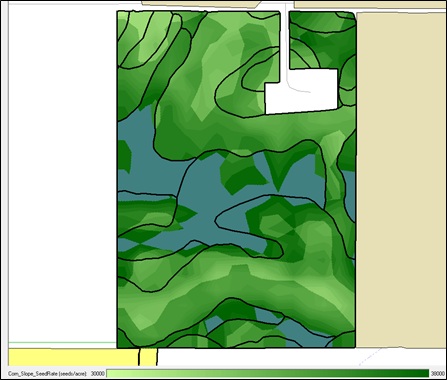
Below is a VR seed map for corn with original SSURGO map overlaid.  You can see how the slope extends the normal zone rates across various soil types.  To accomplish this we started with a VR-Seed map based on soil type and then used some logarithmic math to distribute based on a proprietary slope algorithm.  The lower position in the hill (at same slope) gets more seed than does the same slope toward the hill top.  In fact, the math effectively describes the concave or convex proprieties of all “hills and valleys” at the given 100 ft square resolution.

Additionally, this VR-Seed file means that the farmer won’t have those hard polygon transitions while traversing the field.  In fact, the rates will gradually shift higher or lower as he transitions between soils and varying slopes.  Same soil type but in a valley?  No problem… we’ll drop more seed.  Same soil but on the top of the hill?  No problem, we are dialing back.  This elevation influenced data is able to be accomplished even with WAAS data because of the relative nature of slope position and 100 ft horizontal resolution.    The ultimate result is a refined seed rate without a crop consultant even visiting the field.

The final map is our proposed VR-Seed map for soybeans.  As you might notice we invert the rates to lower population to prevent lodging in the appropriate positions in valley of high OM soil types.  At this point, we believe a good farmer could “trump” these maps with his knowledge about drainage, fertility or other oddities not represented in these two data sets that make his soils different than the underlying SSURGO properties.  (or, subdivide his SSURGO using smart zone soil sampling first and then apply this slope logic afterward!) 

We look forward to bringing this to more customers as we streamline the algorithms and make it easy for more people to deploy inside Optmzr

Monday, February 4, 2013

My first ever re-blog Post

If you've ever wondered about staying power, technology and convergence of mind, guts and glory on the farm... look no further than my friend Brian Scott, aka @TheFarmersLife.  Nice post about Super Bowl commercial that incorporates his family.

http://thefarmerslife.wordpress.com/2013/02/04/ram-trucks-wins-superbowl-with-so-god-made-a-farmer/

I'd say more but his post says enough.

Daryl